
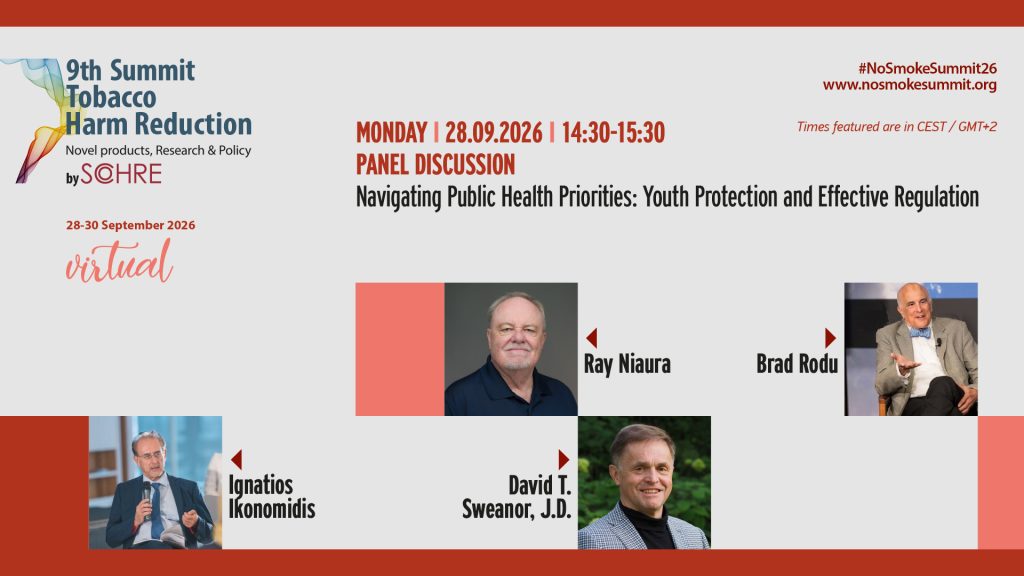
The first Panel Discussion of the 9th Tobacco Harm Reduction Summit, chaired by President of SCOHRE Professor Ignatios Ikonomidis, was held with the participation of three distinguished speakers, Professors Ray Niaura & Brad Rodu from USA and Professor David T. Sweanor J.D. from Canada. The discussion focused on recent trends in tobacco use, vaping and risky behaviors among young people and the need to balance tobacco harm reduction strategies with youth protection through a rational regulatory approach and framework.
Are the kids alright? Recent developments in US youth tobacco product use, risk context, and prevention
Professor Niaura & Dr. Rodu presented population data on cigarette smoking and vaping prevalence rates in the US from the National Health Interview Survey 2014-2025 and the National Youth Tobacco Survey 2011-2025, demonstrating that vaping has, in fact, begun replacing smoking since 2014.
Presenting 2024 U.S. cigarette-smoking data, Professor Niaura explained that recent data show a very low smoking prevalence up to approximately age 17, a peak between ages 35 and 64, and a subsequent decline, while leaving unresolved whether the pattern reflects aging-related initiation or a broader population decline.
Professor Sweanor highlighted the magnitude of the decline in youth smoking, contrasting current patterns with historical Canadian data in which 42% of 15-to-19-year-olds smoked daily, and he characterized the movement of smoking prevalence toward older age groups as a major social and public-health transition.
Compared to cigarette smoking, vaping is a somewhat different story since it is more prevalent among younger adults, peaking between the ages of 21 and 34, Professor Niaura said. A matter of considerable concern, not only in the U.S., but worldwide, is whether vaping represents a new habit or a transition away from combustible tobacco.
Professor Rodu reviewed National Health Interview Survey data and explained that presenting smoking and vaping separately can make vaping appear to be an uncontrolled epidemic. He reported growth in vaping to approximately 18 million users followed by a decline, alongside an increasing share of vapers who were former smokers.
National Youth Tobacco Survey data from 2011 through 2025, for smoking-only, dual-use, and vaping-only categories, show that before 2011, smoking rates were quite high, he continued. Youth smoking fell sharply as vaping emerged, vaping peaked in 2019, and vaping then declined continuously for approximately six years.
Then, Dr. Rodu examined National Health Interview Survey data for 18-to-20-year-olds from 2010 onward and reported a sharp decline in smoking after vaping began. He characterized vaping as replacing some smoking and noted that total nicotine use from smoking and vaping combined had generally declined. So, vaping is not a new epidemic, he explained, but rather a replacement or a substitute for smoking, which for public health is a wonderful scenario.
2025 age-group data show that smoking remains highest among adults of approximately 35 years old and older, Dr. Rodu said. This is an issue of particular concern, since these older smokers are most exposed to smoking-related diseases and have had the least exposure to vaping, he argued, and highlighted the need for greater accessibility and understanding of vaping among this population.
Professor Niaura contrasted National Health Interview Survey data with National Study on Drug Use and Health findings and noted their broad convergence. He reviewed 2018-2025 youth tobacco use data, emphasizing e-cigarette prevalence, historically low cigarette use, and the very low prevalence of nicotine pouches use.
Product-specific and frequency-specific trends
The panel examined product-specific and frequency-specific trends over time. Tobacco use declined steadily after the 2019 vaping epidemic, while nicotine pouches use showed a modest increase concentrated in intermittent use; participants discussed why percentage-doubling headlines can misrepresent very low absolute prevalence. To support that something that has very low prevalence has doubled is really quite misleading, Professor Sweanor said; you have to put everything in perspective.
Professor Niaura introduced Monitoring the Future Survey, a population-based study of high school students, according which complete abstinence from substances among 8th, 10th, and 12th grade students has been remarkably increased from 1975 to 2025. Professor Sweanor noted parallel declines in alcohol use and other risky behaviors, while stressing that the causes of this broad social change remain uncertain. We are seeing a very significant social transformation and we don’t really know what’s causing it and we don’t do enough work to try to figure out what’s causing it, he explained. But if you don’t know what’s leading to healthier behaviors -he wondered- how can you maintain them?
Youth behaviors measured in the Youth Risk Behavior Survey
Panelists reviewed declining or generally low trends in cannabis, alcohol, and illicit drug use other than cannabis. In contrast, daily energy-drink use increased across grade levels and approached 20% of the youth population.
Dr. Rodu placed teen vaping in the context of other youth behaviors measured in the Youth Risk Behavior Survey. He argued that teen vaping has been overemphasized and is still portrayed in the media as an epidemic, despite the fact that its prevalence is dropping since 2019. Public discussion should also recognize other serious concerns, he said, such as unsafe driving, suicide-related indicators, and unsafe sexual activity.
Professor Niaura reviewed indicators of persistent sadness or hopelessness and poor self-rated mental health, noting that levels remain alarmingly high despite recent declines. He also highlighted continuing concerns about difficulty concentrating, remembering, or making decisions, and discussed with the panel the possibility that concentration difficulties among young people may be related to energy-drink, caffeine, or nicotine use. Professor Sweanor emphasized that some people may use nicotine for perceived attention-related benefits and argued that understanding the reasons behind psychoactive-substance use could clarify patterns of substitution and cigarette consumption.
Commenting on data regarding persistent youth sleep deficits and rising social-media use, Professor Niaura connected declining in-person socialization, particularly among 15- to 25-year-olds, with a possible reduction in the peer processes that introduce, model, and reinforce tobacco and drug use. One hypothesis for why we are seeing less drug use and less tobacco product use, he explained, is because there’s less socialization. The social process is important in terms of introducing people to tobacco products, modeling the behavior, sharing information. And that may be going down as a process because people are just not literally socializing with themselves in person anymore.
Professor Niaura presented also declines in U.S. reading and math scores among middle- and high-school students, as well as comparable declines across OECD countries, and framed these trends alongside substance use, technology use, sleep, and socialization as part of a broader unresolved question about complex youth behavior.
Youth protection and effective regulation
Further on, discussion turned to youth protection and effective regulation. Strategies reviewed included taxation and price increases, mass-media campaigns, flavor restrictions, Tobacco-21 Laws, and school-based efforts, with discussion focused on whether their evidence base is as strong as commonly claimed.
Professor Niaura reviewed a recent meta-analysis examining the impact of Tobacco-21 policies on youth tobacco use. The reported overall estimate suggested a 1% reduction in smoking, but the result was not statistically significant, he said.
The participants questioned whether established tobacco-control measures have delivered their full potential and whether additional enforcement, bans, or higher costs are warranted. Dr. Rodu advocated a society-wide approach to youth protection, while David Sweanor reviewed the benefits and limits of taxation and other conventional policies.
We must try to keep kids safe enough until they graduate school and get through the first years of college, and that includes across-the-board behaviors, Professor Rodu said. It isn’t about tobacco or regulating tobacco as much as protecting our youth. And we have to get the parents involved, the teachers involved, and everybody involved, he explained.
David Sweanor argued that tobacco-control policy often fails to distinguish the risks of combustible cigarettes from those of non-combustible nicotine products, and he called for actionable messaging, risk-proportionate regulation, and better public understanding of substitution as a way to reduce smoking. It is quite concerning, he mentioned, the fact that a lot of people who are vaping or cigarette smoking, especially young people, don’t understand the difference in risk. So they may be vaping, but they are vaping because it doesn’t smell as bad, or often it is less expensive, but they are not being properly informed in order to make it more likely that they would switch.
Balancing adult switching and youth prevention
Professor Ikonomidis raised the challenge of helping older smokers switch without encouraging new youth nicotine use. The discussion considered changing youth norms, energy drinks, social media, sleep, and other behaviors as part of the broader context for prevention.
Professor Niaura said tobacco-control policy must move beyond repeating past approaches and engage more deeply with the current youth environment. We have reached a crossroads where we need to try to get ahead of the curve, to open our minds and think deeply about what’s really going on with youth today, he said. Professor Sweanor argued that the largest public-health gains would come from helping adults quit cigarettes, while accounting for the effects of smoking on families, second-hand exposure, and household finances.
Professor Ikonomidis endorsed informed choices, harm reduction, and government oversight of nicotine products, including controls on ingredients and quality. If you have 10 dangerous situations, it is good at least to reduce it to nine or eight or in half, if we can, he said. Best choices are made when one is very well informed. Of course, human beings like to have some things in our daily life that satisfy them, and nicotine use may be one of them. In order to minimize the risk, we need regulation and control by the government, by the health politics, Mr. Ikonomidis concluded.