
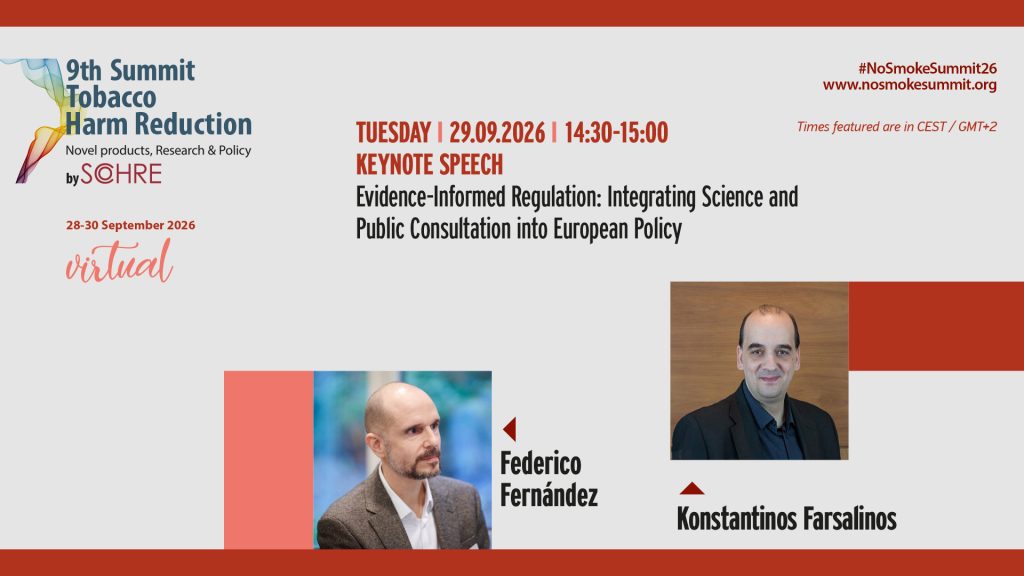
In view of the upcoming Tobacco Products Directive, the European Union initiated a public consultation and a call for evidence, which has attracted thousands of submissions. Konstaninos Farsalinos invited Federico N. Fernández, the CEO of We Are Innovation, a global network of over fifty think tanks, NGOs and foundations, to present their analysis on these submissions and their findings, and to share his viewpoints concerning the outcome of this consultation.
Mr. Federico N. Fernández first pointed out that 24% of adults in the EU still smoke and that in Spain, a country that is very hostile towards innovative nicotine products, smoking rate showed a decline of just 5% in 20 years (from 2007 to 2025), dropping to 27%. On the other hand, smoking rate in Sweden is below 5% and the country has reached the threshold of smoke-free. All these countries are part of the same single market, they are all under the same Tobacco Products Directive (TDP), and they are all following the same suggestions and indications by the WHO. And the results are very, very different. This gap should be very interesting for a regulator, the speaker noted.
Mr. Fernández then emphasized that evidence-informed regulation means a process that looks at data like the ones above and is willing to change course because of it. He added that evidence-informed regulation relies on three sources and one principle; science, data, and public consultation are the three sources and proportionality is the principle (choosing the least restrictive measure that achieves the goal). All these standards exist in the EU regulation toolbox, in paper, the speaker said, but the problem regarding the TPD is that they have not been applied — at least not yet.
Focusing on the case of Sweden, Mr. Fernández said that Sweden applied basically the whole guidelines and rulebook of the traditional so-called tobacco control: high cigarette taxes, indoor bans, warnings, educational campaigns. With one difference: in Sweden, basically from the very beginning, safer alternatives were available for smokers who wanted to switch. Moreover, in 1971, Sweden started taxing tobacco according to its risk, and in 2024, the Swedish government raised taxes on cigarettes, lowered them on snus, and kept pouches as the lowest taxed product. As a result, lung cancer prevalence in Sweden is 36% lower than the EU average.
Mr. Fernández then referred to an evaluation report of the tobacco directives that the Commission published in April 2026, which, as the speaker said, cost several million euros and is 144 pages long; and the term “harm reduction” appears twice, whereas terms related to prohibition appear 74 times. The speaker went on presenting several omissions of the evaluation. For instance, the Commission relied on a scientific opinion that does not compare the risks of vaping and smoking; the studies used were all from before 2017; the opinion of 77% of the consumers who replied that vaping, pouches, and heated tobacco could help people stop smoking was put in an annex; the report has not analyzed illegal trade.
Focusing on the analysis using LLM models that his team carried out on the submissions made this summer, after the EU call for a public consultation, Mr. Fernández said that there have been 82,000 submissions from 138 countries and the analysis showed that 91% of the submissions raised at least one strong objection to the Commission’s directive; about 2% supported it. Further analysis showed three main topics of concern:
- cost: compliance costs are paid upfront and reduce the budget available for research; small companies are the ones that are hit the hardest,
- incentives: if companies cannot show that a product is lower risk, they compete on price and scale; this favours large companies, imports and illegal sellers, and
- uncertainty: if rules are reopened repeatedly, investments are delayed or moved outside of the EU.
Mr. Fernández added that his team made five recommendations based on these results and their beliefs: i) regulation should be based on relative risk, ii) the cost to innovation should be assessed, iii) the effects on jobs and the economy, in general, should be measured, iv) the effect on illegal trade should be anticipated, and v) the regulatory board’s standards of evidence should be met before adopting certain measures.
In conclusion, Mr. Fernández presented five final remarks on what an evidence-informed TPD revision should include: i) compare the risks of different products, as Parliament requested in 2022, ii) publish a transparent analysis of the consultation responses, iii) apply the full Better Regulation toolbox, including SMEs, enforceability and competitiveness, iv) explain why smoking rates range from 5% to 37% under the same law, and v) set indicators in advance and review results against them.
Discussion
Mr. Farsalinos commented that we have real world examples where the approach of accepting and using harm reduction as a tool to combat smoking has worked; and we have the opposite examples that show that prohibition bans and targeting harm reduction has miserably failed. Therefore, he asked the speaker how optimistic he is whether his recommendations are going to be truly implemented, considering the public statements from EU Commission officials.
Mr. Fernández replied that despair is never a good solution. He added that the body of scientific evidence that shows how much safer the innovative products are compared to cigarettes is growing and that, in his opinion, the current EU Parliament is slightly more open than previous Parliaments towards innovative nicotine products. It is certainly going to be an uphill battle, and each minute of delay has a very powerful and very unfortunate human cost, but there are a lot of reasons to be optimistic, he concluded.
Mr. Farsalinos called for accountability for unsupported official claims and argued that regulation is preferable to prohibition, because it preserves quality standards and government control. He reminded that the TPD 2014 was mostly based on common sense rather than evidence, as it was too early to have a lot of evidence. “It is a paradox that while, over the years, evidence has mounted on the lower risk of innovative products, the regulatory pathway seems to follow the opposite side, moving towards more prohibitions”, he pointed out. Let’s hope that common sense and evidence will prevail, Mr. Farsalinos concluded.