
Public health interventions are typically evaluated by their financial cost: prevention, treatment, and policy implementation estimated expenditures. However, the value of prevention and the toll of preventable harm are not measured only in mortality and morbidity; they are also measured in quality of life, healthcare expenditure, lost productivity, pressure on public budgets, and ultimately, economic growth and social welfare.
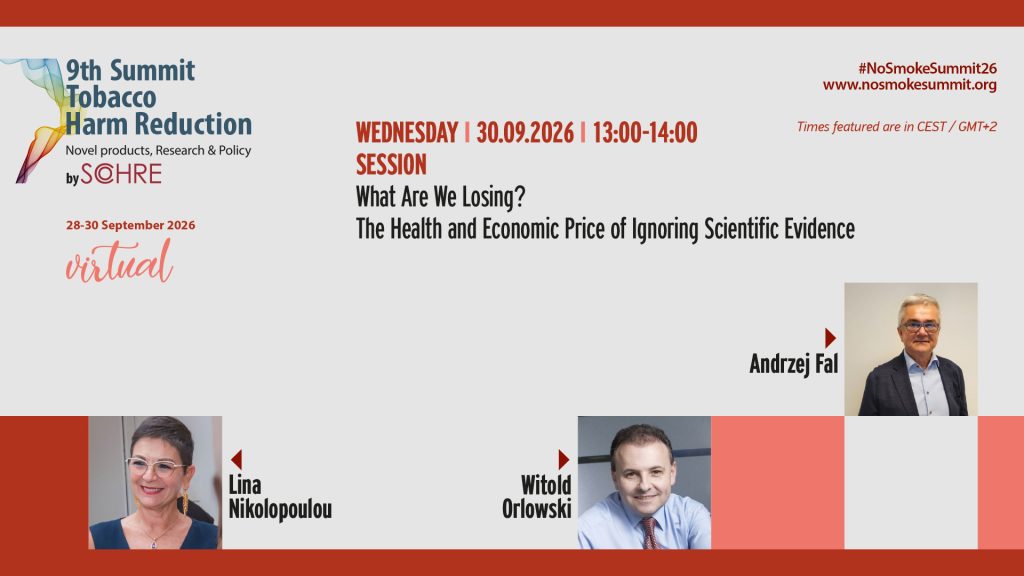
On the final day of the Summit, Dr. Lina Nikolopoulou moderated a discussion on the broader consequences of preventable harm and the socioeconomic costs of disregarding scientific evidence. As Dr. Nikolopoulou noted in her opening remarks, on 28 September, the European Parliament’s Committee on Public Health (SANT) adopted its implementation report on Europe’s Beating Cancer Plan (BECA plan), which includes proposals for stricter regulations on tobacco and nicotine products.
This development contrasted with the European Parliament’s adoption of a cardiovascular disease strategy, only two weeks prior, which explicitly acknowledges that differences in nicotine content and delivery methods may result in differentiated risk profiles across products, while recognising that all such products carry health risks. These developments raise two critical questions that must be addressed in the context of EU public health policy: how can we ensure that scientific evidence is consistently translated into public health policy across diverse regulatory areas, and what are the socioeconomic costs of failing to act on evidence?
To the question raised in the discussion of how greater scientific and regulatory coherence can be ensured across different areas of EU public health policy, Professor Fal noted that these developments illustrate the absence of a sufficiently unified approach to health policy at the European level, with individual initiatives often considered in isolation rather than as part of a broader framework. He emphasised the importance of acting on evidence that is already established, while supporting further research where uncertainty remains, so that future policy decisions can become progressively more coherent and evidence based.
The health perspective and the burden of preventable disease
There is a dangerous assumption that the excise and value-added taxes generated by tobacco and alcohol consumption largely offset, or nearly offset, the public expenditure required to manage their associated health consequences. The case of Poland over the past five years clearly demonstrates that this assumption is entirely false, Professor Andrzej Fal, President of the Polish Society of Public Health, stated.
Professor Fal explained that 75% of non-communicable chronic diseases (NCDs) are driven by avoidable behavioral factors. In the WHO European Region, approximately 1.8 million people die annually from NCDs, he said. Furthermore, recent data from the European Union indicates that the direct cost of major NCDs reaches 500 billion euros, supplemented by more than 500 bn euros in annual lost productivity, thereby bringing the total economic burden of NCDs in the EU to 1 trillion euros annually. Of these 1.8 million NCD deaths, 60% are entirely preventable. The remaining 40% are inevitable cases that depend strictly on clinical treatment rather than preventative measures.
Describing the vicious circle of failing to adequately fund prevention, Professor Fal explained that historical underinvestment first allowed modifiable risk factors to drive a high incidence of NCDs. This surge significantly increased Disability-Adjusted Life Years (DALYs) and Years of Life Lost (YLL), leading to a loss in productivity that shrank the tax base. Consequently, the fiscal contraction reduced future public budgets, leaving fewer resources to fund prevention moving forward. Ultimately, he concluded, the less a nation invests in prevention, the lower its tax revenues become, further diminishing its capacity to fund preventative measures in the future.
The epidemiological burden
In Poland, 25% of cancer deaths are still linked to cigarette smoking, while approximately 7% are alcohol related. Beyond occupational hazards, which are not entirely avoidable, there are five major risk factors that can be effectively mitigated if nations implement the right strategic policies. Among those, smoking alone accounts for 20% of all deaths in Poland due to tobacco-related diseases, while alcohol consumption is responsible for over 10% of the nation’s total DALYs. Obesity and diet, the third in the series of behavioral risk factors, are responsible for just under 4 years of reduced life expectancy across the OECD. Combined, these risk factors cost Poland more than 5 years in life expectancy — the penalty for not acting. The cost for the Polish nation is approximately 9% of GDP.
In Poland, DALYs lost per 100,000 people due to cigarette smoking are nearly 6,000. While hypertension and high body mass index represent the second and third major risk factors respectively, DALYs loss due to cigarette smoking remains 20-25% higher. This burden is not evenly distributed across the country, highlighting the health disparities not only across Europe, but also within Poland itself.
Regarding tobacco-attributable mortality, smoking causes approximately 70,000 to 80,000 deaths annually. Over 25% of all male deaths are attributable to smoking-related diseases, compared to nearly 14% (approximately one in eight) for women. A 30-year comparison between smoking and alcohol consumption reveals that, while tobacco-related harm has shown slight improvement, alcohol consumption is a fast-rising problem. Furthermore, alcohol-related mortality typically peaks among individuals aged 40 to 45, whereas tobacco-related mortality peaks much later, among those aged 55 to 60.
Economic liabilities
Three years ago, at the request of the Polish Parliament, the Polish Society of Public Health prepared a comprehensive analysis, Professor Fal said. This evaluation demonstrated that the total annual financial liability attributable to smoking stands at approximately 92 billion zlotys (equivalent to 20-23 bn euros annually). While direct medical costs (comprising National Health Fund expenditures, hospitalizations, oncology, and cardiology) account for approximately 50 bn zlotys, the indirect costs of tobacco-related diseases are frequently overlooked. These include lost workforce productivity due to presenteeism, absenteeism, early retirement, and premature mortality. Combined, these factors culminate in a total economic burden of 92 bn zlotys.
According to projections by the UN World Population Prospects, Poland, which currently has a population of approximately 38 million, is estimated to see it decline to 19 million within the next 70 years. At the same time, the working-age population will constitute less than 50% of society. This means that while the workforce is expected to contract significantly due to demographic changes, it is further depleted by the premature loss of workers to preventable diseases.
For 2025, Poland’s budget revenue from tobacco excise duties was estimated at approximately 33 bn zlotys (38-39 bn zlotys including VAT). However, when considering direct (50 bn) and indirect medical costs (42 bn), the tobacco sector yields a net economic loss of 54 bn zlotys. For alcohol, the net loss exceeds 80 bn zlotys. Combined, the net loss of 135 bn zlotys generated by these two factors proves absolutely false the theory that taxation of these substances offsets their societal and healthcare costs.
On the other hand, taxation remains a necessary tool. Poland and Bulgaria have the highest affordability of cigarettes when measured against median monthly income. However, excise taxation must be combined with two other tools, Professor Fal underlined, youth prevention and education, and adult harm reduction.
While clinical proof of harm reduction is still emerging, there is unequivocal proof of exposure reduction. Consequently, public health policy must differentiate between traditional combustible cigarettes, heated tobacco products, electronic cigarettes, and other nicotine delivery systems.
In 2023, the AOTMiT (the state-owned HTA agency in Poland) recommended a strategic shift from cigarette smoking to less harmful alternatives. However, funding remains the primary obstacle. In 2019, the National Health Fund allocated 2.5 bn zlotys to the treatment of tobacco-attributable diseases, whereas the budget for smoking cessation programs was slashed from 240,000 to 60,000 zlotys.
The clinical reality in Poland, Professor Fal concluded, is that 40% of all deaths are attributable to alcohol consumption and cigarette smoking. The resulting socioeconomic drain exceeds 40 bn euros annually. Tolerating such a deficit poses a direct threat to a shrinking labor force. Therefore, the country must integrate strict non-fiscal barriers to access, minimum pricing in relation to average salary, and adult harm reduction strategies.
Asked about the different approaches reflected in the European Parliament’s cardiovascular disease strategy and the Beating Cancer Plan debate, Professor Fal argued that Europe still lacks a sufficiently coherent health-policy approach across policy areas. His conclusion was straightforward: we must act on what is known, and where uncertainty remains, fund the research needed to resolve it.
The economic perspective: what preventable harm means for healthcare spending, productivity, public finance, and economic growth
Poland has achieved great economic success over the past three decades, with income rising from approximately 30% of Germany’s purchasing power parity (PPP) to nearly 80%, Professor of Economics Witold Orlowski said. Upon joining the European Union in 2004, Poland’s GDP was 2.5 times smaller than that of the United Kingdom; today, the nation is approaching the UK and has recently surpassed Japan in GDP per capita. Consequently, alongside Ireland, Poland has stood as the fastest growing economy in Europe over the last 30 years.
However, GDP is not the sole metric of national well-being, Professor Orlowski added. According to public opinion surveys conducted over the past two years, health problems remain the number one fear among Polish citizens. This fear stems directly from the unsatisfactory performance of the healthcare system. Increased financing alone cannot resolve all problems; the critical challenge is the way this money is spent. Since Poland’s EU accession, healthcare expenditures have risen from less than 6% of GDP to over 8% currently and are projected to reach 9% next year. Despite this substantial increase, the system has failed to improve public health outcomes or patient satisfaction.
Poland is an aging society, characterized by a growing retirement-age population requiring increased healthcare expenditure, alongside a concurrently shrinking workforce. Besides this demographic pressure, individuals often compromise their own health through preventable behaviors, such as smoking. In 1990, over 50% of adult Poles were smokers; today, this figure has declined to approximately 27%, which nevertheless remains above the European Union average.
The total cost of smoking is estimated at approximately 2.5% to 3% of Poland’s GDP, with direct medical expenditures accounting for one-fourth of this amount and indirect costs —such as lost productivity and the broader burden of disease— comprising the remaining three-fourths. This economic burden is three times greater than the tobacco excise revenues collected by the Polish government, and twice the size of the nation’s total expenditure on research and development.
While tobacco products generate tax revenue in the short term, they simultaneously account for substantial direct healthcare costs and productivity losses, the speaker concluded. Combined, the net loss for public finances is several times larger than the tax revenue collected. This imbalance leads to measures, higher public debt, elevated interest rates, and slower GDP growth. Fighting tobacco consumption through strategic funding of prevention measures leads to higher GDP growth.
Discussion
Responding to Dr. Nikolopoulou’s question on how to convince politicians to invest more in prevention, Professor Fal responded that local governments are those who should invest. The central government, he explained, will never be that close to the citizens. The only thing that should be done centrally at parliamentary level is to set rules and regulations that set thresholds, for example, obliging local governments to spend no less than 6% of their budgets on prevention. Unfortunately, most politicians and economists still see spending on prevention as spending, not investing. Investing brings profit in the future; spending is money you never get back, he explained.
Convincing politicians is not easy because they have their own agenda, and tax money is money they see immediately, while the gains from better health must be explained to them, Professor Orłowski agreed. Therefore, the healthcare system must work in a clever way to properly channel resources into fighting tobacco consumption.
The real challenge is, Professor Fal added, that policymakers don’t want to really discuss with us. All external invitations to discussion or comments are rather negative or saying, ‘it has to be as it is.’ To persuade policymakers, you need to start talking to them, and that requires agreement on both sides. No matter how good the research or intentions are, none will produce results if there is no contact. We need to stay in touch with decision makers, scientists, and societies to make the questioning and answering really loud. Otherwise, we will stay at this crossroads instead of moving ahead.
The cost of doing nothing is huge; scientists need to keep trying to provide analyses to politicians and play an important role in convincing that we should go forward with evidence-based policymaking, Dr. Nikolopoulou underlined, before thanking the panel for the illuminating session.