
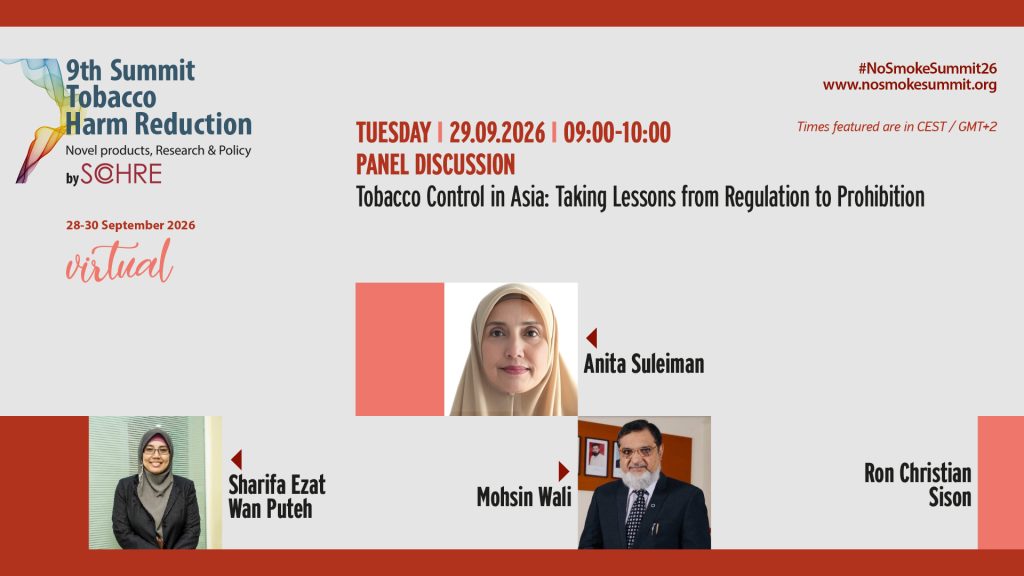
Professor of Public Health Sharifa Ezat Wan Puteh moderated a discussion of great interest, which focused on the complex landscape of tobacco use and regulation in Asia, and the importance of balanced regulation and harm reduction strategies to effectively address tobacco and nicotine use in the region.
Highlighting the significant burden of tobacco consumption in Asia, Professor Wan Puteh pointed out in her opening remarks that Asia is divided between regulated access models, implemented in countries such as Malaysia, Philippines, and Indonesia, and prohibition-based policies, implemented in countries like Singapore, Hong Kong, and India. Harm reduction is a broad concept, she explained, that often encounters significant political, cultural, and professional resistance before becoming an accepted practice.
Malaysia’s Harm Reduction policy shift
Dr. Anita Suleiman, President of the Malaysian non-governmental organization Harm Reduction Action Network (HaRAN), spoke about Malaysia’s transition from opposition to acceptance of HIV harm reduction, describing a gradual change driven by epidemiological evidence, which reframed the issue around HIV prevention through collaboration among government, healthcare, community, religious, law enforcement, and affected person groups.
Dr. Suleiman outlined principles for tobacco harm reduction, including complementing cessation, avoiding moral judgment, protecting smokers who cannot quit, regulating products, monitoring outcomes, and communicating relative risk honestly. Policy should be judged by reductions in cigarette use, serious illness, and premature deaths, she pointed out.
Tobacco harm reduction is not a retreat from prevention and cessation, it’s an additional public health duty, the speaker said. We should reduce avoidable harm among adults who continue to smoke despite our best efforts, and we should not allow moral judgment to dictate public health action. Smokers who cannot quit or are unable to quit should not be abandoned, Dr. Suleiman underlined; they deserve accurate information about available options that may reduce the harm. Communication must be honest, she continued, alternative products should never be labeled as safe or harmless; but, at the same time, not all products should be labeled as carrying the exact same level of risk as cigarettes.
The deeper lesson from HIV, Dr. Suleiman concluded, is that we must meet people where they are while continuing our work towards better health for the nation. Resistance diminished when harm reduction stopped being discussed only as an idea and began showing real results.
“Tobacco harm reduction should be judged in the same way, not by slogans, not by product, but by whether fewer people smoke cigarettes, fewer people become seriously ill, and fewer families suffer from the loss of a beloved person.”
India’s Tobacco Landscape and Control System
Professor Mohsin Wali described India’s wide range of smoked and oral tobacco products, tobacco-control campaigns, regulatory institutions, advertising restrictions, public-place smoking bans, and the persistent gap between written rules and implementation.
India is the world’s second largest consumer and producer of tobacco and tobacco products. A variety of tobacco products are available in the country, including cigars, edible tobacco products, branded products etc., but all alternative tobacco products, such as pods, electronic cigarettes, heat-not-burn products, and some of the herbal tobacco products are totally banned in the country, and their import, use, and consumption is not allowed.
He referred to India’s tobacco control efforts that include the Gen Z Tobacco Free Youth Campaign, the COTPA Act, the National Tobacco Control Program, and the Illicit Trade Protocol Implement Action.
The Cigarette and Other Tobacco Products prohibition, advertisement, and regulation of trade and commerce products supply and distribution Act (COTPA), enacted by the Parliament in 2003, has the primary objective to reduce the consumption of tobacco products and protect the health of the citizens of India as a whole, Dr. Wali explained. It is a very strict Act and encompasses various provisions that aim to curb the tobacco epidemic in India, which has significant public health implications due to the various health risks associated with tobacco use, including various types of cancers.
Discussing the restrictions on tobacco sales and the limited availability of permitted nicotine-replacement products —only nicotine patches and tablets are allowed— he reported that roughly 90% of his patients say they cannot quit bidi or cigarette smoking and argued that the lack of official authorization for safer alternatives is a significant barrier.
Dr. Wali also highlighted the contradiction between health professionals’ advice and their own smoking behavior, as well as the economic dependence of farmers on tobacco cultivation. He proposed starting harm reduction education in primary schools, with teachers educating children and engaging closely with families.
“In order to change public behavior in India —he underlined— it is crucial that all stakeholders dedicated to tobacco control must lead by example, adhering to the very advice they promote to the public.”
Discussion
Public health must protect everyone, including children, non-smokers, families, smokers seeking cessation, and smokers who continue to use tobacco, said Professor Suleiman. No one should be left behind, she continued, comparing tobacco harm reduction with HIV harm reduction and arguing that protecting smokers who are not ready to quit does not mean endorsing smoking.
A person does not lose the right to health because he or she smokes. All persons have the right to respectful healthcare, accurate information, and practical options that help them reduce avoidable risks. This does not mean approving of smoking or giving up on cessation, Professor Suleiman added. Quitting all tobacco products remains the ideal outcome, but policies must be pragmatic. Smokers should be continuously encouraged and supported to quit; however, if they cannot, they should still receive accurate information. They should be told that no alternative product is harm-free, but moving completely away from combustible cigarettes to a regulated non-combustible product may help them reduce the harm. This is public health, she concluded.
Dr. Wali mentioned grey-market availability in India, the difficulty of quitting, the potential role of heated or other non-combustible products, and the importance of education, political will, availability, and addressing fatalistic beliefs among smokers.
The discussion shifted to the challenges of applying evidence from the UK, Europe, and the United States in Asian settings. Professor Suleiman distinguished broadly applicable scientific evidence from locally variable behavior and market conditions, and recommended adapting policies to local circumstances while monitoring their effects. People’s behavior and the way markets operate can vary significantly across countries, she explained. Smoking habits, income levels, prices, cultural attitudes, regulations, and access to healthcare differ in Asian countries. Asia is a diverse, not-homogeneous region; some countries regulate alternative nicotine products, while others ban them outright. Furthermore, while some nations have strong enforcement capacity, but others still struggle with online sales, informal sellers, and illegal products. Asian countries should not simply copy Western policies and assume they will work, nor should they reject useful evidence simply because it comes from the West. The sensible approach is to learn from international evidence, adapt it to local contexts, and then monitor what happens locally.
Describing Malaysia’s 2024 Control of Smoking Products for Public Health Act as a legal framework covering cigarettes, electronic cigarettes, and other smoking products, Professor Suleiman emphasized that implementation requires effective product standards, youth-sale prevention, advertising and online-sales controls, and action against illegal products and illicit trade.
Stating that the policy objective is to reduce cigarette smoking, disease, premature death, and youth nicotine initiation rather than increase alternative-product sales, she called for monitoring smoking prevalence, complete switching, dual use, and youth initiation, alongside sufficient and timely cessation services and differentiated communication for non-smokers, people seeking cessation, and continuing smokers.
Professor Wan Puteh emphasized the need to discourage dual use and encourage complete switching away from combustible tobacco. In response to her question about reaching smokers more effectively, Dr. Wali described using family histories, personal risk counseling, nicotine patches, spiritual and medical arguments, and direct warnings about severe health consequences.
When he argued that tobacco use will not decline without intervention at the production level, and he called for political will to restrict tobacco farming, support alternative agricultural production, and give cigarette manufacturers viable alternatives, the moderator raised the challenge of replacing tobacco with alternative crops while protecting small farming communities. Dr. Wali described the severe economic hardship of women producing bidis and called for a coordinated response to the tobacco industry and its supply chain.