
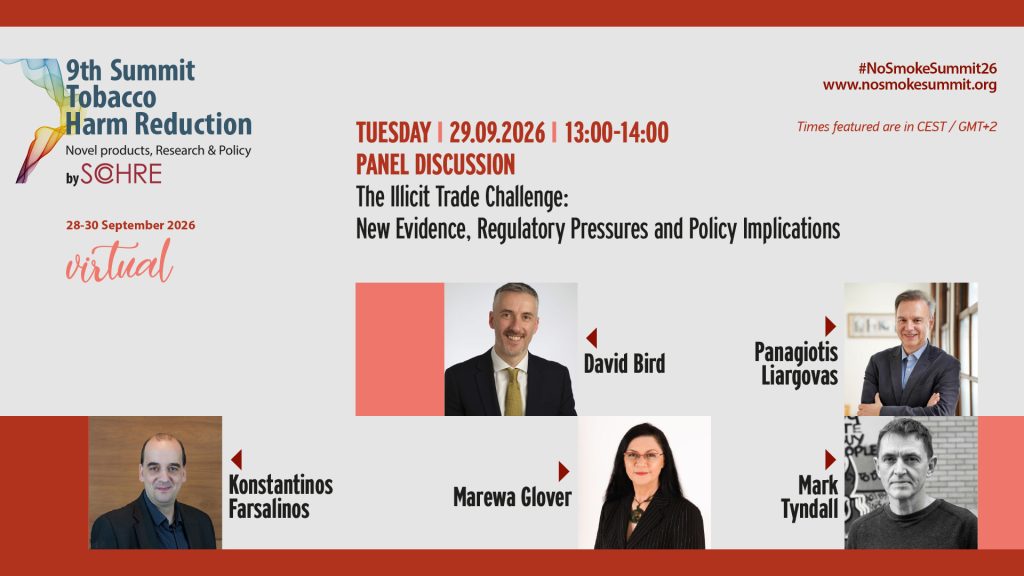
What would the best regulations and policies on nicotine products be, based on new evidence? Can we reduce illicit trade and at the same time maintain a continuous smoking rate reduction? Is it fair to tax vape products at the same level as cigarettes, or would a risk-proportionate taxation be more rational? Konstantinos Farsalinos invited four distinguished speakers to present recent data and comment on those subjects, in view of the new EU Tobacco Products Directive (TPD).
Trends of nicotine products consumption and evolution of illicit nicotine products
The first speaker, David Bird, presented the trends of nicotine products consumption and, importantly within that, the evolution of illicit nicotine products in Europe and in Greece over the past five years, focusing mainly on illicit cigarettes, but also talking briefly about heated tobacco and oral nicotine products.
Mr. Bird first clarified the terminology used for illicit cigarette trade: counterfeit cigarettes are illegally manufactured products that are sold by someone other than the trademark owner; illicit whites are cigarettes that may be manufactured legally in one country, but are smuggled across borders to their destination market, where they have limited or no legal distribution and are sold without payment of tax; and contraband cigarettes are genuine products that have either been bought in a lower tax country, exceeding the import limits, or have been acquired to be resold illegally in another market.
He then presented figures showing how cigarette consumption is declining in Europe; this decline is mainly driven by a decline in legal cigarette sales. However,
illicit cigarette consumption is increasing, mainly due to counterfeit products, depriving the EU and the European governments of 22 billion euros in tax revenue.
Mr. Bird also noted that, in terms of share, 11% of all cigarettes consumed in 2025 was illicit (more than one in 10).
Another important trend that Mr. Bird highlighted is the fact that organized criminal groups involved in the illicit cigarette trade are becoming more coordinated and professional and illicit supply chains are becoming more modular and distributed, using new technologies, like drones, QR codes, and online sales. As a result, law enforcement is getting harder and requires end-to-end and cross border coordination. The speaker added that France is by far the largest consumer of illicit cigarettes in Europe, followed by the UK and Ukraine. On the other hand, Greece and Ukraine are the only two European markets where illicit cigarette consumption is declining.
Moving to other nicotine products, Mr. Bird said that the consumption of heated tobacco is growing and that only 1% of heated tobacco products is illicit, as opposed to the 11% for cigarettes. The oral nicotine products are very much dominated by nicotine pouches, whereas snus and chewing tobacco are not as present in a lot of markets, due to regulation restrictions in many countries. In fact, different regulatory regimes across European countries lead to very different market compositions.
Finally, Mr. Bird focused on Greece, where cigarette consumption is declining, in line with the rest of Europe; however, this decline is primarily driven by a decline in illicit cigarette consumption, against the trend seen elsewhere in Europe. Two or three years ago, 20-25% of cigarettes consumed in Greece were illicit —he added— but that number has now fallen to 14%. He also stressed that Greece is one of the fastest-growing markets for heated tobacco consumption.
Tobacco Taxation and Illicit Trade Landscape in Europe
The next speaker, Prof. Panagiotis Liargovas, depicted the landscape of tobacco taxation and illicit trade in Europe, based on the KPMG report, to which Mr. Bird referred.
The important question we should be asking ourselves, the speaker stressed, is not whether taxation works, but what the relationship between tobacco taxation and illicit trade is; he reminded the audience that tobacco taxation is and should remain an important public health instrument. He added that we should consider what happens when taxation changes not only the absolute price of cigarettes, but also the relative price between the legal and the illegal market. With a 44% reduction in total cigarette consumption, Europe has succeeded in shrinking the cigarette market, but the illicit component of that smaller market has become relatively larger and far more geographically diversified, he explained.
Prof. Liargovas then referred to the current debate over the EU tobacco taxation directive and the proposal for higher minimum excise levels and coverage of heated tobacco, e-cigarette liquids, and nicotine pouches. He described the existing disagreement over the proposal’s scale, speed, and structure, but he highlighted the fact that there is a broad recognition that the existing framework needs modernization.
Finally, Prof. Liargovas referred to the research taking place at KEPE (Hellenic Center of Planning and Economic Research), which raised the question of whether the EU should look only at nominal tax rates or also at the economic shock that the tax change creates in each individual market. The right question for policymakers, Prof. Liargovas said, is how can taxation be designed so that it reduces harmful consumption, without unintentionally strengthening the illicit market. That, according to his opinion, requires three things: calibration (the size and speed of tax increases matter), differentiation (differences across products and across national economics matter), and enforcement (a tax strategy without an anti-illicit trade strategy is incomplete). As Prof. Liargovas emphasized,
Tax policy and anti-illicit trade policy should not be designed in separate rooms.
Nicotine product tax policies and regulations in New Zealand and Australia
Mrs. Marewa Glover was then invited to present the cases of New Zealand and Australia, two countries with large differences in their nicotine product tax policies and regulations, and their relevant outcomes.
As Mrs. Glover said, it is estimated that 33.5% of cigarettes and loose tobacco products consumption in New Zealand is illicit, whereas in Australia 80% of all nicotine products are illicit (50-60% of tobacco products and about 96% of the vape products).
Both countries have consistently had very high tax increases; nicotine product tax rates in Australia and New Zealand are the highest in the world. In New Zealand, illicit cigarettes are sold at half price compared to the legal products. In Australia, the legal pack price of cigarettes has tripled since 2016, whereas the illegal product price has not. In terms of lost excise, the New Zealand government has lost $817 million, whereas Australia has lost $7.7-11.8 billion; this difference cannot be fully attributed to the difference in the population size.
Mrs. Glover then described border control and law enforcement efforts in both countries, which have led to big operations, arrestations, confiscation of large quantities of illicit products, and shop closures. She noted that organized criminal networks coming from overseas are now starting to operate in New Zealand; in Australia, the illicit markets are mainly run by outlaw motorcycle gangs and transnational groups, and gang rivalry leads to extortions and fire bombings.
The most striking difference between the two countries is seen in the area of vaping products. New Zealand has legalized and regulated vaping, there are licensed vape retailers, and vaping products are available in a range of flavors and strengths. The share of illicit vaping products is very little. Unfortunately, oral nicotine pouches have been banned and their import and sale are prohibited. In Australia, access to vaping is highly restricted and almost prohibited. As a result, about 96% of vapes are supplied via the illicit market.
Mrs. Glover then outlined the existing and proposed enforcement measures in New Zealand and Australia, including tougher penalties, new agencies, funding, and proposed excise changes. Finally, she presented New Zealand’s declining smoking prevalence and rising vaping prevalence, as a substitution pattern; she attributed the recent plateau in progress to misinformation, to the absence of oral nicotine pouches, and to the increasingly cheap illicit cigarettes.
A Comment on EU policies
Reflecting on the recent vote in the European Parliament’s Committee on Public Health (SANT) on 28 September concerning the implementation of the European Beating Cancer Plan (BECA), panelists raised concerns about whether certain proposed measures targeting alternative nicotine products are fully aligned with the Plan’s overarching objective of reducing smoking-related disease and cancer.
The discussion highlighted evidence suggesting that product characteristics, including nicotine delivery and flavor availability, may influence adult smokers’ willingness to switch away from cigarettes, while also questioning whether the same regulatory and fiscal approaches should apply across products with different risk profiles.
Reference was made to the Swedish experience, where very low smoking prevalence and substantially lower lung cancer rates have coincided with the widespread use of non-combustible nicotine products. Overall, the speakers emphasized the importance of ensuring that future tobacco control and cancer prevention policies remain evidence-based and take into account the potential role of risk differentiation in accelerating progress toward a smoke-free Europe.
Last speaker, Mark Tyndall, was invited by the chair to specifically comment on the recent European tendency to target alternative to smoking nicotine products, particularly flavors, despite the fact that they help people quit smoking, and while the recently developed European Beating Cancer Plan is basically based on the idea that we should move to prevention rather than treatment.
Mr. Tyndall called the current situation an “insanity”, noting that illegal market is the sign of bad public health policies. Turning the whole cigarette market over to drug cartels is not a good public health policy, he argued. He expressed the fear that, at this point, it is too late, given the example of Australia, where 80% of nicotine products is served by the illegal market. “We have made such an opening for criminal organizations, and I don’t think we can defeat them; we have seen that with other harder drugs”, he said emphatically.
Mr. Tyndall stressed that we need to deal with the over one billion people who are slowly killing themselves from cigarettes and that those are the people we really need to be reaching.
Nicotine pouches are not causing cancer, and vaping is not causing cancer, he said. The goal should be to reduce the consumption of combustible tobacco, and we have really lost that goal from our sight.
If our current goal is to prevent any new people from trying nicotine, this goal is totally misplaced, the speaker said and underlined that we should have regulations that really address the needs of people who are currently smoking. If we chose taxations that are proportionate to risk, and given that non-combustible nicotine products are 95% safer, we would have free safe nicotine products, Mr. Tyndall concluded.
Conclusions
Mr. Farsalinos closed the session expressing his thoughts. He also pointed out the irony of Europe creating a Beating Cancer Plan and at the same time ignoring the country which has almost beaten cancer. Presenting the numbers on Sweden, he stressed that this country has an annual incidence rate of lung cancer of 39 cases per 100,000 population, versus 95 in the EU; Sweden also achieved a smoking rate of 4.8% in 2025, beating the goal that the EU has set for 2040. Yet, the policies that Sweden has followed to achieve this goal are not only ignored, but they are considered an annoyance by the EU officials. The EU has banned snus all over Europe except Sweden, and now wants to ban nicotine pouches. It is an irrational approach, Mr. Farsalinos argued.
Apart from prohibition and restrictions, taxation is another component of public health policies, he added. The EU plans to double or even more than double the taxation on harm reduction products, bringing them to a level similar or even higher than tobacco cigarettes. Equating taxation means that the alternative lower-risk products are going to be more expensive than smoking. That doesn’t make sense from a public health policy approach and perhaps it does not make sense from a fiscal perspective either, Mr. Farsalinos concluded.